
Built to Last, Hard to Explain: The Industrial B2B Messaging Problem
Apr 01, 2026
The C-suite for a 100M dollar industrial company walks into a boardroom. They have the fleet, the manufacturing capacity, and the service team to truly scale in the market.
But when the CEO, the VP of Sales, and the Head of Operations are asked what makes the company different, you get three different answers. None of those answers are repeatable. Most are buried in technical jargon that a customer doesn’t care about.
This is not a sales team problem.
It is not a product problem.
This is, without a doubt, a messaging problem.
And there are a lot of reasons to fix messaging problems. Namely? Millions of dollars more in revenue, per year.
In this extensive blog, here’s what we’ll breakdown:
- Why strong companies struggle to explain what makes them different
- The hidden cost of unclear messaging
- What effective messaging actually looks like
- A framework to align your team and scale your story
Growth usually happens through grit, relationships, and product quality. You built a serious business by being better at the work than the guy down the street. You let the work speak for itself. For the first few decades, that worked. But as you scale past 100M dollars, the narrative can start to fracture.
When you are small, the founder or CEO is the chief storyteller. They are in every high level meeting, hammering home the vision. But as you grow, you hire more people. You acquire. You expand into new territories. Suddenly, you have 50 salespeople across the country ad-libbing their own version of the pitch. They are using pocket lines they invented themselves because the official sales deck is a 40 page slide show of features and specifications that puts prospects to sleep.
This together creates a context gap. You and your leadership team are experts. You live inside the machine every day. You have so much context that you assume your customers understand your value. They do not. They are not experts (which is exactly why they hire you). They see a list of features and a price tag. If they cannot distinguish your value from the white noise of your competitors, they will choose the lower price every single time.
The Cost of Unclear Messaging
Unclear messaging is a quiet tax on your P&L. It shows up in ways that most CEOs do not associate with marketing.
- Sales cycles get longer. When your team cannot explain the outcome in 30 seconds, the prospect has to do the heavy lifting. They have to translate your technical specs into a business case for their own CFO. If you make the customer work to understand you, they will find someone easier to buy from.
- Price pressure increases. If you sound like everyone else, you are a commodity. Commodities are bought on price. If your messaging is built around phrases like “best quality” and “best service,” you are using the most expensive words in the industrial sector. Everyone says they have quality and service. If you cannot find your white space, you are stuck in a race to the bottom.
- New market expansion stalls. You might be the king of logistics in the Midwest, but when you try to move into energy or construction in the South, your legacy reputation does not follow you. You need a narrative that scales. Without it, you are starting from zero in every new vertical.
- Talent acquisition suffers. The best engineers and operators want to work for companies that have a clear mission. If your external brand looks like it was designed in 1995 and reads like a technical manual, you will struggle to recruit the next generation of leadership.
- Get more out of current customers. Consistently telling your story to current customers can increase your revenue 10-20% annually fairly quickly (studies have proven that brands that consistently tell their story are doing 20-33% more revenue than brands that don't).
The Curse of Operational Excellence
Most company leaders are operationally excellent but messaging-averse. You value things you can measure, like uptime, throughput, and safety ratings. Marketing feels like fluff. You have probably been burned by agencies that wanted to talk about brand colors and logos when you wanted to talk about revenue.
But storytelling is not art. It is narrative infrastructure. It is an operational asset that ensures your team is aligned. When your messaging is fractured, your operations are fractured. If marketing is saying one thing and sales is saying another, you are wasting money on both ends of the house.
What Good Messaging Looks Like
Good messaging in the B2B space is direct, repeatable, and human. It moves away from what you do and focuses on what you solve.
- It is clear and repeatable. If your junior sales associate cannot repeat the core message after one day of training, the message is too complex. You need a Nail, which is what Prologue defines as the sharp, repeatable truth that you are going to hammer in the market. It is the one thing you want the customer to remember when they leave the room.
- It is human, not technical. Your customers are people with careers at stake. They are not just buying a piece of equipment or a logistics contract. They are protecting their reputation. They are trying to avoid a shutdown that costs them $50,000 dollars (or more) per hour. Your messaging should speak to that fear and that ambition.
- It creates white space. Most companies live in oversaturation and white noise. They all say the same things. Good messaging identifies what your competitors are ignoring and what your customers want, then plants a flag in that holy ground of unclaimed territory.
The Framework to Fix the Fracture
As organizations mature, the narrative fractures. The end result is often a brand that sounds like multiple different businesses vying for attention instead of one business with a robust offering. Brands with great messaging have a planned flow or messaging hierarchy to what customers should know. Brands with no messaging get stuck in saying “and we do this, and this, and this” in a never ending pitch of everything all at once.
When you pitch everything all at once, you pitch nothing memorable.
We help build the source of truth, creating a unified message system that aligns with what customers find most valuable, and ultimately what drives revenue.
1. The Nail: This is the sharp, repeatable truth that we're going to hammer in everything we do. It will pierce through market noise. The Nail becomes the anchor for a broader strategic narrative.
2. Brand Voice: We create distinctive Brand Voice Guidelines, which are rules of engagement that allow a team of 50 to write with the consistency of one, either with a copywriter or Premise (our AI tool).
3. Positioning & Messaging: Every framework helps your team visualize your position in the market, and establishes primary and secondary messaging that establishes a narrative example of how we tell our story.
Operationalizing the Story
Once you have the framework, you have to ensure it survives contact with the real world. This is where most companies fail. They build a beautiful brand book that sits on a shelf and never gets used. Prologue doesn’t build these coffee table books. Instead, we focus on building action plans, and scaling the plan.
Scaling your story is where it often breaks down. In the age of AI, it’s even harder. Your team is already using AI to write emails and proposals. If they are using standard tools, they are generating off message content at best, and slop at worst. This is generic, low quality content that dilutes your brand.
We solve this with Premise, which acts as your brand's Private Copywriter. We take your Messaging Framework and train an AI instance specifically on your story and your rules. This puts guardrails around the technology. It allows your team to move with speed without sacrificing quality. Everyone has a copywriter working for them now. It ensures that even a new hire can write an email that would be CEO and marketing approved.
The Path Forward
If your business is “hard to explain because we do so much,” you are capping your own growth. How much money are you leaving on the table? Our team has utilized Story Discovery Audits to find tens of millions in annual revenue that was left on the table because clients weren’t successfully telling their story. And we’ve put millions of dollars back into businesses with work work.
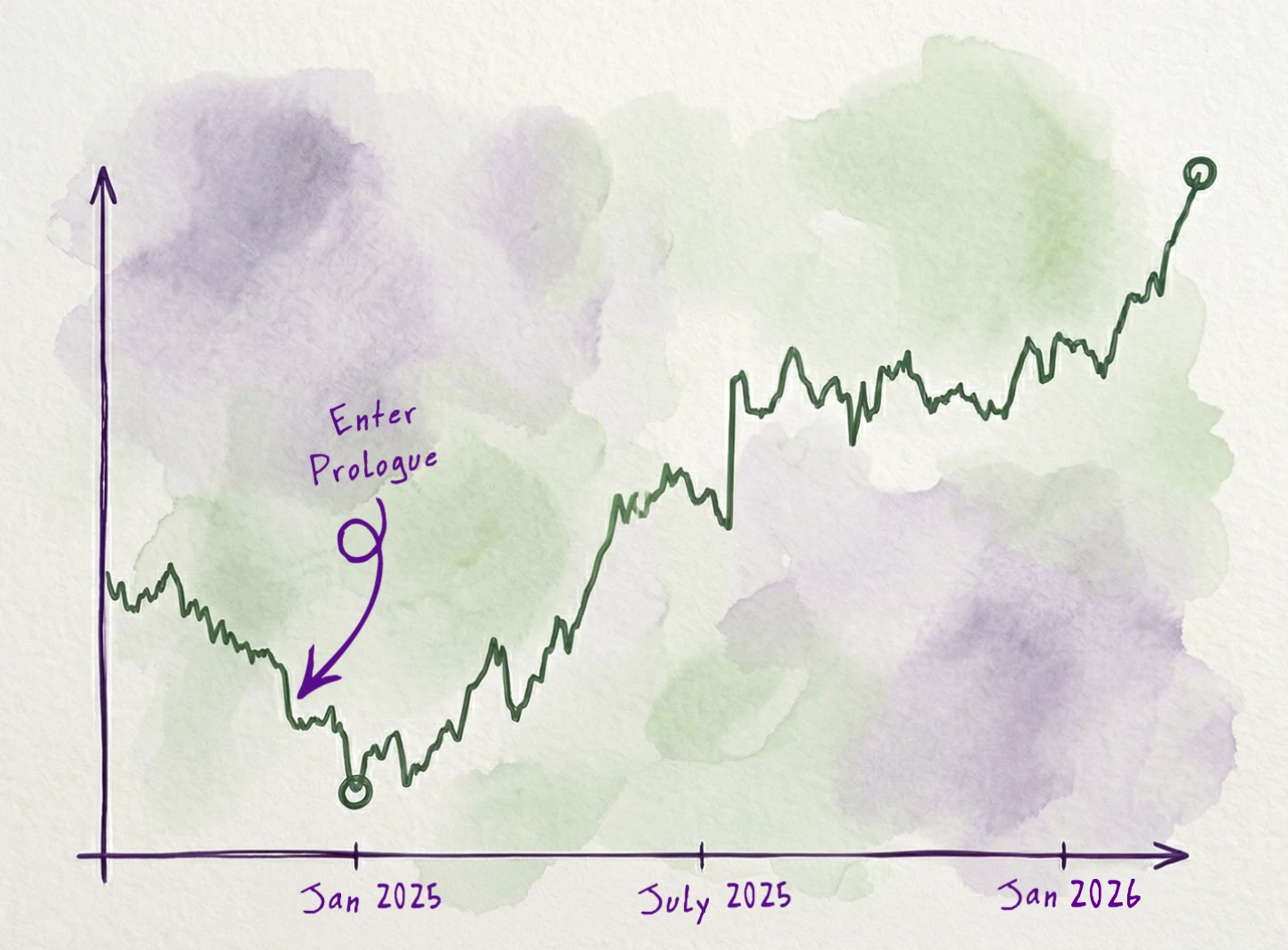
Prologue has helped consistently increase one client’s core service for 15 consecutive months.
It is time to treat your story with the same level of discipline you bring to your operations.
If you are ready to design a story that sells and scales, let's talk.
Great Stories Start Here.

